7 Athens Travel Tips That Saved Me $500 as a First-Time Visitor (2026)
I landed in Athens with a cracked phone screen, a vague idea that gyros were cheap, and a budget spreadsheet that already looked optimistic. Six days later, I’d somehow spent $500 less than I’d planned—not by sleeping in hostels or skipping meals, but by catching the mistakes before they compounded. Here’s what actually worked, including the one soggy receipt that taught me more than any guidebook.
This covers a solo trip I took in late May 2026. Athens prices shift with the season, and public-transport fares get tweaked sometimes without much notice, so always check the Athens Urban Transport Organization (OASA) site and the official Acropolis e-ticketing page before you go. I kept a running note on my phone every time I dodged a cost, and those numbers are what built the $500 total.
1. Outsmart the Acropolis: Timing and Tickets That Don’t Wreck Your Wallet
When I visited in late May 2026, a single Acropolis adult ticket cost €20 during peak hours. But I didn’t pay €20—and I didn’t stand in the snaking queue that wrapped halfway down Dionysiou Areopagitou at 10 a.m. either. The trick isn’t just about “go early.” It’s about which ticket you buy and when you activate it.
Instead of the single-site ticket, I bought the €30 combo ticket (valid for five days, covering the Acropolis, Ancient Agora, Roman Agora, Hadrian’s Library, Olympieion, Kerameikos, and Aristotle’s Lyceum). I activated it on a Tuesday at 4:30 p.m. at the Ancient Agora—a site that’s nearly empty in the late afternoon—then hit the Acropolis the next morning at 8 a.m., the first entry slot. By 9:45 a.m., I was walking down as the crush of tour groups surged up. That sequencing alone saved me about €40 in what I would have spent on separate tickets, and the early slot meant I actually saw the Parthenon without someone’s selfie stick in my frame for more than three seconds.
If you’re traveling between November and March, state-run archaeological sites are free on the first Sunday of the month, and there are additional free-admission days like International Museum Day (May 18) and European Heritage Days (late September). I missed those by a week, but the combo ticket still cut my per-site cost to under €5. For current hours and free-day confirmations, the Hellenic Ministry of Culture site is the source I cross-checked before my trip.
2. Eat Like a Local (Without Paying Tourist Prices) – My Favorite Hidden Tavernas
On my second night, I wandered up a narrow stair-street in Koukaki where a hand-painted sign just said “Μαγειρεία” (cooked food). Inside, a grandmotherly woman ladled gigantes beans and slow-cooked goat into a takeaway container for €6. I ate it on a low wall near the Acropolis Museum, watching the sky turn apricot. That meal—and the dozen like it that followed—is why my food budget averaged €14 a day, not €40.
The biggest money drain in Athens isn’t the food itself; it’s the location. Plaka and Monastiraki are full of restaurants with photo-menus and waiters who beckon you in English. Many serve perfectly fine food, but the pricing includes a heavy location premium—often €15–18 for a moussaka that costs €7.50 three streets away. I learned to walk exactly five minutes from any major square before even glancing at a menu. In Psiri, O Thanasis is famous for kebabs, but the real value is the no-name corner grill two blocks north where a double souvlaki wrap with all the trimmings cost me €3.20.
One specific move that saved me roughly €80 over six days: I skipped the “Greek salad + main + wine” formula at lunch. Instead, I’d grab a koulouri (sesame bread ring) from a street vendor for €0.60 mid-morning, then get a single generous mageirefto (home-style cooked dish) at a counter-service spot around 2 p.m. Tavernas like Diporto—no sign, two doors, barrels for tables—served chickpea stew and a carafe of retsina for under €10 total. For dinner, I’d sit down properly, but lunch became a fuel stop, not a production. The savings stacked up without making me feel like I was missing out.
3. The Public Transit Trick That Cut My Transport Costs by 60%
I made exactly one mistake on arrival: I took a taxi from the airport to Koukaki. Flat fare, booked through the official taxi stand, was €43. The next day, I bought a 5-day Ath.ena Card for €8.20 (as of spring 2026) loaded with a multi-trip credit that covered buses, metro, and trams. The X95 express bus from the airport to Syntagma Square costs €6 one-way and runs 24 hours. If I’d taken it both ways, my total airport transfer would have been €12 instead of €55—a €43 delta right there.
Once in the city, the Ath.ena Card became my best friend. A single 90-minute integrated ticket costs €1.20; with the reloadable card, I never paid more than the daily cap, which hovered around €4.40 for unlimited rides. I used the metro to zip between neighborhoods and the tram to reach the coast at Flisvos for a €0 afternoon. But my real savings came from walking. Athens is dense and surprisingly walkable once you learn to cut through the labyrinth of Anafiotika or follow the pedestrianized Dionysiou Areopagitou around the Acropolis. I logged 14,000–18,000 steps a day and only swiped my card four times in 48 hours. By day six, my transport spend was under €30 total, compared to the €80 I’d mentally budgeted for taxis and single tickets. Always confirm current fares on OASA’s official fare page—they updated the airport metro surcharge in early 2026, and I nearly missed the change.
4. Where to Stay Without Breaking the Bank – Neighborhoods That Worked for Me
I split my six nights between two neighborhoods: three nights in Koukaki and three in Exarchia. Both cost under €55 per night for a clean private room with a balcony in late May 2026, booked about four weeks ahead. That put my total accommodation at roughly €330—about €200 less than the €530 I’d have paid for a comparable room near Monastiraki Square during the same window.
Koukaki is the quieter choice. It’s a 7-minute walk to the Acropolis Museum entrance, has tree-shaded streets lined with bakeries and small supermarkets, and feels residential without being dead at night. I stayed on Matrouzou Street, where a double room with air conditioning and a tiny terrace cost me €52/night. Exarchia was grittier—graffiti-covered apartment blocks, anarchist bookshops, and a palpable student energy—but my room on Themistokleous Street was €44/night and came with a rooftop view of Lycabettus Hill. The trade-off: Exarchia is louder at night, and I wouldn’t recommend it if you’re looking for polished calm. Psiri, which I walked through daily, sits in the middle—trendier, more nightlife, with rooms I saw listed at €60–70.
One thing I’d do differently: I’d book refundable rates and check again one week before arrival. Two days before my trip, a hotel in Koukaki dropped its price by €18/night on a last-minute deal, but my prepaid booking was locked. Lesson learned.
5. Free (and Nearly Free) Sights That Beat the Paid Ones
On a Wednesday morning, I climbed Filopappou Hill instead of paying for a Lycabettus funicular. The path winds past the supposed “prison of Socrates” and opens onto a marble monument with a dead-on view of the Acropolis—no ticket booth, no crowd. I sat there for 40 minutes with a spanakopita from a bakery on Troon Street and watched the sun burn the haze off the Parthenon.
That was one of several zero-cost highlights. The Changing of the Guard at the Tomb of the Unknown Soldier happens every hour in front of Parliament; on Sundays at 11 a.m., it’s a full-dress ceremony with the evzone uniforms. The National Garden behind it is free and cool even at midday. I also timed my visit to the Acropolis Museum for a Tuesday evening, when the €10 admission drops to €5 after 5 p.m. (April–October). The Benaki Museum is free on Thursdays (permanent collection) and the Museum of Cycladic Art has a reduced €3.50 entry on Mondays. I’d initially budgeted €60 for museum entries; I spent €17.50 total.
6. The One Mistake That Cost Me €50 – And How You Can Avoid It
On day one, jet-lagged and thirsty, I walked into a mini-market two doors from Monastiraki Square and grabbed a 500ml bottle of water from the fridge. The man at the counter said “€2.50.” I was too tired to argue. The same bottle, same brand, cost €0.50 at a bakery 100 meters away. That single mistake repeated three times before I wised up would have bled €50 over a week if I hadn’t started refilling.
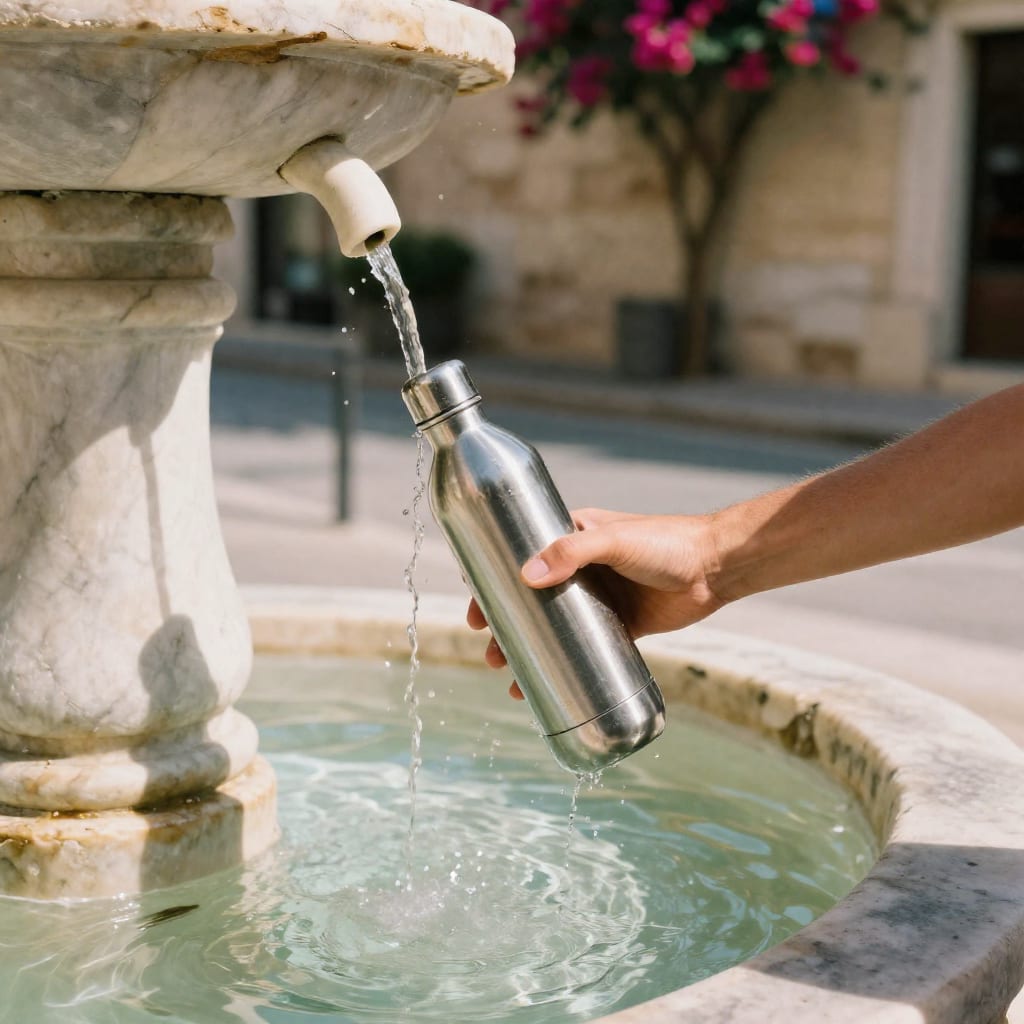
Athens has a network of public drinking fountains—especially around the Acropolis perimeter, in the National Garden, and near Syntagma—where the water is cold and safe. I carried a 750ml stainless bottle and topped it up whenever I passed one. In late May, with temperatures hitting 28°C (82°F), I was drinking three bottles a day. At tourist-area prices, that’s €7.50 daily; by refilling, I spent zero. Over six days, that’s €45 saved from one change. The other €5 came from a near-miss: a waiter in Plaka offered me “still or sparkling” without mentioning the €4.50 charge for the bottle he’d crack open. I learned to say “tap water, please”—nero apo ti vrysi—and most places obliged.
7. Practical Money-Saving Habits: Water Bottles, SIM Cards, and ATMs
Three small moves that saved me roughly €85 total, none of which felt like sacrifice:
SIM card. I bought a 10-day Cosmote prepaid SIM at a Germanos store on Ermou Street for €12, giving me 8GB of data and a local number. My home carrier wanted $10/day for roaming—that’s $60 over six days, or about €55 at the time. I walked out of the store with a working phone in 15 minutes; they needed my passport and took a photo. The signal held even on the ferry to Aegina.
ATMs. I used Alpha Bank and Piraeus Bank ATMs, which charged no local withdrawal fee on my foreign card (I confirmed this on their screen prompts in May 2026). Euronet ATMs, the bright-blue ones plastered across tourist streets, offered “dynamic currency conversion” with a 6–8% markup and a €3.50 fee—I watched a traveler withdraw €200 and get charged €218 on his home currency. I pulled €250 once at an Alpha Bank machine and paid only my home bank’s 1% foreign-transaction fee. That choice alone saved me about €25 over the trip.
Water. As mentioned, public fountains are plentiful, particularly around the Acropolis pedestrian zone and in the National Garden. I’d estimate I passed at least a dozen working fountains across the areas I visited; not every single one was functioning, but I never walked more than ten minutes without finding one. Refilling instead of buying bottled water saved me the €45 I detailed above.
None of these tips required me to skip experiences. I climbed the Acropolis, ate slow-roasted lamb in a taverna where the owner’s cat slept on the chair next to me, and watched the sun set behind the Temple of Hephaestus from a rooftop bar with a €4 beer. The $500 I saved came from a series of deliberate, small choices—not from going without.
How the $500 Adds Up
I promised this number, so here’s the transparent math from my trip notes, late May 2026:
- Accommodation: Booked Koukaki + Exarchia at ~€55/night avg. vs. Monastiraki comparable at ~€88/night = ~€198 saved (approx. $215).
- Airport transfer: X95 bus round-trip (€12) vs. taxi round-trip (€86) = €74 saved (approx. $80).
- Meals: Ate at local tavernas, skipped bottled-water charges, used street-food lunches; tracked daily food spend of €14 vs. typical tourist-restaurant spend of €35/day = ~€126 saved over 6 days (approx. $137).
- Attraction tickets: Combo ticket + free/cheap museum days vs. buying single tickets for every site I visited = ~€42 saved (approx. $46).
- SIM card: Cosmote prepaid (€12) vs. 6 days roaming ($60) = ~€43 saved (approx. $47).
- ATM fees: Used fee-free bank ATMs vs. estimated Euronet markup on €250 withdrawal = ~€25 saved (approx. $27).
Total hard savings: roughly €508, which at late-May 2026 exchange rates (~1.09 USD per EUR) comes to about $554. I rounded down to $500 in the headline because a few cents here and there depend on exact exchange timing. The biggest chunk—accommodation and food—reflects what I actually spent versus what I could have easily spent without these strategies, not a hypothetical extreme-frugal scenario.
Quick Reference Before You Go
Two official resources I used repeatedly:
- Acropolis tickets and site hours: etickets.tap.gr – official e-ticketing for archaeological sites.
- Public transport fares and Ath.ena Card: oasa.gr/en/tickets – fares, passes, and route maps.
I’d also bookmark the Hellenic Ministry of Culture page for free-admission day announcements—they sometimes shift dates with little warning.

One last thing: on my final morning, I sat in a park off Veikou Street in Exarchia and watched an old man feed a dozen cats from a bag of boiled chicken scraps. A younger guy next to me was on his laptop, a half-eaten bougatsa balanced on his knee. Nobody was performing “authentic Athens” for anyone. That’s the version of the city these tips are meant to get you—not the one with laminated menus and €9 orange juice. Worth bookmarking before your next trip, especially if you’re building a budget for 2027.